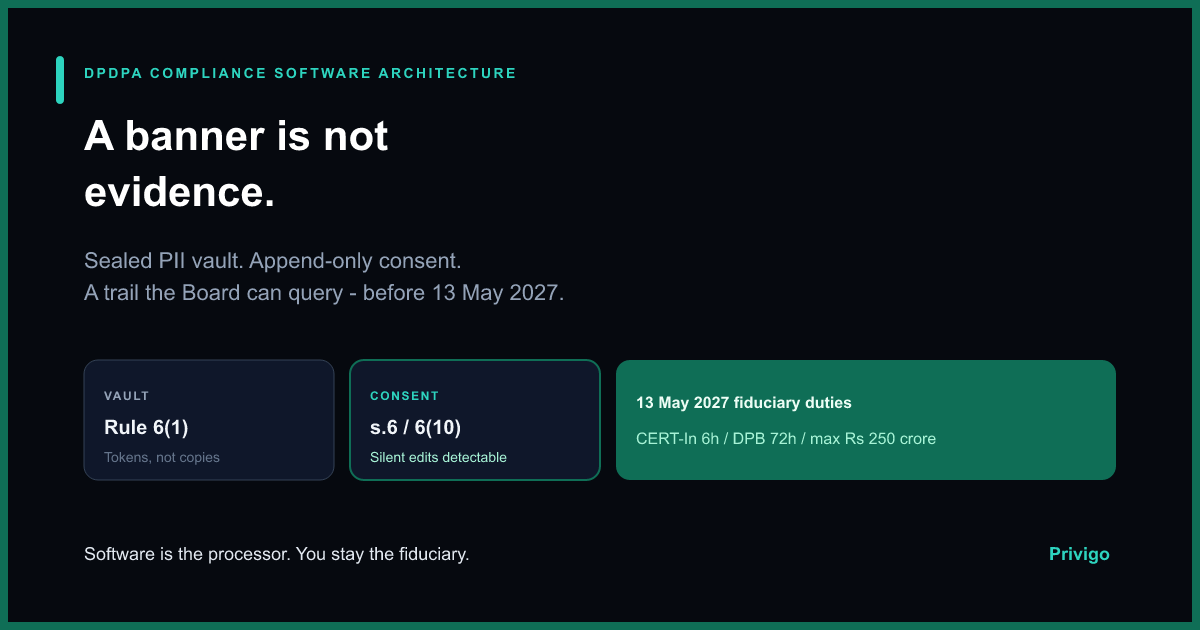
A DPDPA software comparison India that ranks banners will pick the wrong tool. The Digital Personal Data Protection Act, 2023 asks whether you can reconstruct a lawful ground on a named day. Privigo, Digio’s CoTrust, and Consently are built for three different jobs. This page is published by Privigo; weigh the first recommendation accordingly.
TL;DR
- DPDPA software comparison India in 2026 is an architecture test, not a widget test. Score where identifiers sit, whether a consent row can be silently edited, and whether the dual clock can be scoped.
- Consently leads the web consent surface: automated cookie discovery and notices in all 22 Eighth Schedule languages via Bhashini (as published on their site, reviewed for this update against Privigo’s 31 July 2026 compare page).
- Digio CoTrust leads enterprise / BFSI packaging: ROPA-centric consent, SaaS or on-premise, KYC/e-sign adjacency, and public claims of tamper-evident records. Digio also names the product a Consent Manager — that is marketing, not a Board registration.
- Privigo leads evidentiary architecture for Indian SMBs and mid-market institutions: sealed PII vault, append-only chained consent, point-in-time notice reconstruction. Cookie discovery is not the lead capability.
- None of the three is a registered Consent Manager as at 16 September 2026. Rule 4 registration commences 13 November 2026. Software is not your DPO and not your Rule 13 auditor. Duties phase in on 13 May 2027. Section 8(5) sits under ₹250 crore.
How should a DPDPA software comparison India treat Privigo, Digio, and Consently?
Treat them as three jobs, then match the job to the data you actually hold.
The Digital Personal Data Protection Act, 2023 and the DPDP Rules, 2025 do not care which dashboard looked clean in a demo. Section 6(10) puts the burden of proving consent on the Data Fiduciary. Rule 6(1) wants encryption, masking or virtual tokens and access control. A leak still starts CERT-In (6 hours) and the Data Protection Board of India (DPB) under Rule 7 (72 hours).
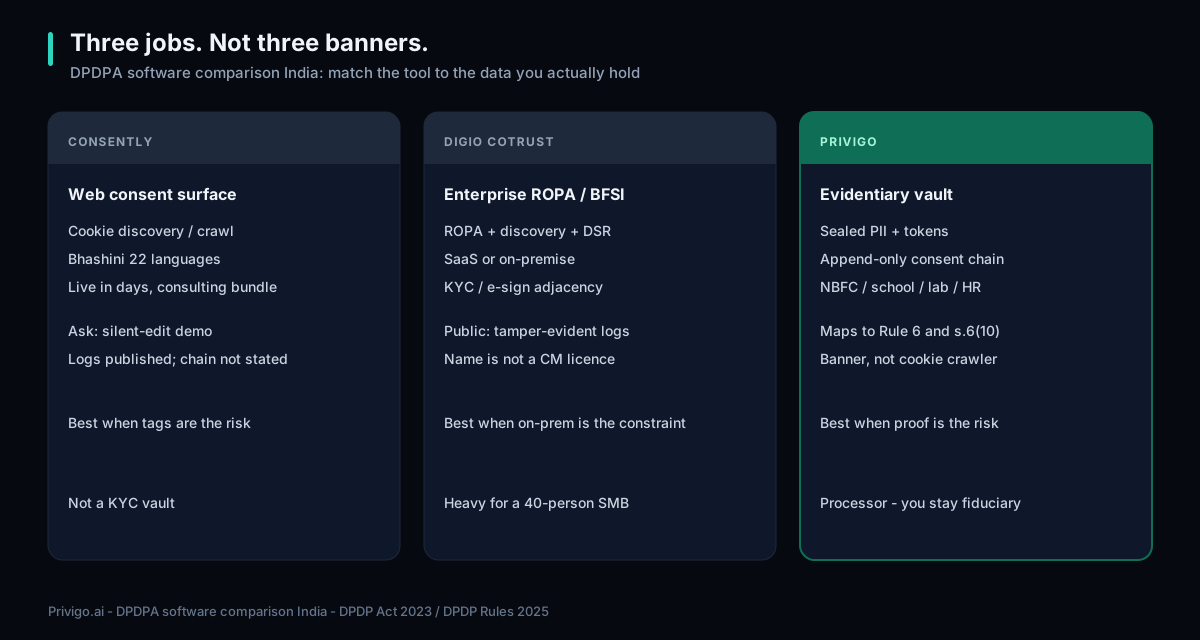
| Job | Typical buyer | Tool that fits the job | What it is not |
|---|---|---|---|
| Inventory tags and serve pan-India web notices fast | B2C site, heavy third-party pixels | Consently | An evidentiary vault for KYC sitting in a LOS |
| ROPA + on-prem consent for a scheduled bank / large enterprise | CISO, core-banking constraints | Digio CoTrust | A 40-person SMB’s first privacy officer |
| Prove what a borrower, patient, parent, or employee was told, years later | NBFC, lab, school, HR / staffing | Privigo | An automated cookie crawler |
Competitor cells below are public-page claims, not lab results. Where a vendor has not published a property, this article says so. Missing copy is not proof of absence — put the question in the demo. The two-way Consently deep-dive stays on Privigo vs Consently; the wider roundup is best DPDPA compliance software. GDPR-first suites fail a different test: DPDPA vs GDPR for Indian SMBs.
The DPDPA does not revive the old SPDI “sensitive personal data” category. Discovery tools that classify “sensitive” fields are doing inventory, not applying a second legal tier.
When is Consently the stronger fit?
When the DPDPA exposure is the public website.
Consently’s published materials (as summarised on Privigo’s 31 July 2026 compare page, re-checked in spirit for this 16 September 2026 update) describe automated cookie scanning at several crawl depths, banners from a script tag, and notices in all 22 Eighth Schedule languages through Bhashini. That addresses Rule 3 for a pan-India consumer audience more directly than a vault-first platform does. They also bundle consulting, which suits a team with no internal privacy owner.
On evidence, Consently publishes timestamped, exportable audit logs. Whether those logs are append-only or silent-edit detectable was not stated publicly as at 31 July 2026. Ask for a live demonstration. Do not score that cell from a brochure.
Rule 3 requires notice in English or any Eighth Schedule language — not a statutory duty to ship all 22. Language coverage is a product strength, not a legal checklist of twenty-two files.
Choose Consently over Privigo if tags and regional notices are the risk. Privigo ships a cookie banner; Consently ships cookie discovery. Those are different capabilities. Blurring them would be dishonest.
Where does Digio’s CoTrust fit if you are a bank or enterprise?
When the constraint is core systems, ROPA, and deployment topology — not a 48-hour SMB banner.
Digio is a digital-trust vendor (KYC, e-sign, account aggregator) that productised CoTrust. Public pages as at 16 September 2026 describe: data discovery and ROPA; unified consent and DSR workflows; a preference centre; SDKs/APIs; SaaS or on-premise (on-prem priced on profiles and connectors); timestamped, purpose-linked, tamper-evident consent records with version history and withdrawal logs; 22-language notices; and withdrawal propagation. Banking-oriented Digio posts also argue on-premise or private cloud for scheduled banks.
Fair strengths: if you already run Digio for KYC/e-sign, if RBI-shaped hosting rules out multi-tenant SaaS, or if legal wants a ROPA object model before the consent widget, CoTrust is in the shortlist. Public “tamper-evident” language is stronger than Consently’s published logs — still make them show silent-edit detection. Do not treat a FAQ sentence as a cryptographic proof.
Two naming traps.
“Consent Manager” on the product page is not Rule 4 registration. Digio blogs say CoTrust is preparing to register when the Board opens that class. Rule 4 commences 13 November 2026. Until a name is on the register, CoTrust is software you buy as a Data Processor. You remain the Data Fiduciary. Section 6(7) makes routing through a registered Consent Manager an option for the individual, not a purchase you must make.
Do not copy Digio blog cites blindly. Some CoTrust explainers map “immutable audit trail” to Section 10(2) (SDF DPO / auditor duties) and imply notices must exist in all Eighth Schedule languages. Those mappings are not how this site reads the Act. Trail evidence is a Section 8 / Section 6(10) problem; SDF extras are Significant Data Fiduciary under DPDPA.
SMB watch-out: discovery + ROPA + on-prem connectors is an enterprise shape. A forty-person NBFC or a 900-student school will pay to administer a great deal they will not use. That is fit, not quality.
What does Privigo’s architecture change that a banner does not?
Three properties, mapped to the Act — the same argument as the platform page.
- Sealed PII vault — identifying data in a separate store; ops systems hold tokens. Maps to Rule 6(1)(a) and 6(1)(b), and to Section 8(5). Tokens remain personal data under Section 2(t).
- Append-only, cryptographically chained consent — notice version, purposes, channel, timestamp, guardian method where relevant. Built for the Section 6(10) reconstruct test.
- Evidentiary trail — export that can feed CERT-In 6h and Rule 7 72h by scoping affected principals. A person still files. Software is not the independent auditor.
Watch-outs, said plainly: cookie discovery is not the lead capability; notice-language pack must be confirmed in a demo (do not assume full Eighth Schedule parity); pricing is quote-based after Gap Analysis, not a public rate card; Privigo is a processor under Section 8(2), not your Section 8(9) contact and not a DPO.
Sequence the rest of the work with the 90-day DPDPA readiness roadmap.
Are any of these tools a registered Consent Manager?
No. Not as at 16 September 2026.
A registered Consent Manager is an India-incorporated intermediary, registered with the Board, with the net-worth and independence conditions in the Rules, that keeps routed personal data unreadable to itself. None of Privigo, Consently, or Digio CoTrust holds that licence today. Buying software does not appoint one. You still need notices that meet Rule 3, itemised Section 6 consent or a named Section 7 use, withdrawal that actually stops processing, and Rule 14 rights machinery.
Rule 13 does not sit in this table. Annual DPIA and independent audit start only after Section 10 notification.
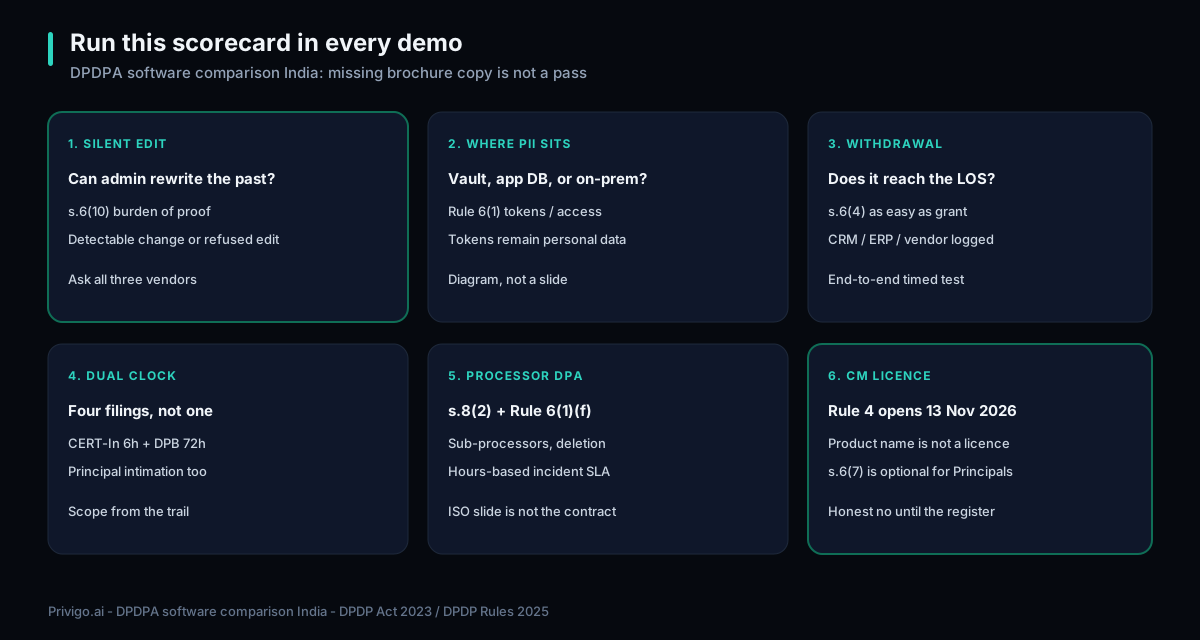
| Demo question | Why it matters | Pass looks like |
|---|---|---|
| Can an admin silently edit a past consent event? | Section 6(10) | Alteration is detectable, or the UI refuses the edit |
| Where does Aadhaar / patient ID / student ID physically sit? | Rule 6(1) | Distinct vault or documented equivalent — not “the app DB is encrypted” as the whole answer |
| Does withdrawal reach CRM / LOS / ERP / vendor? | Section 6(4) | End-to-end, timed, logged |
| Dual-clock: 6h CERT-In + 72h Board, plus Principal intimation | Rule 7 + CERT-In directions | Four filings, not one |
| Processor contract: security, sub-processors, deletion, hours-based incident SLA | Section 8(2), Rule 6(1)(f) | Signed DPA, not an ISO slide |
| Are you selling a Consent Manager licence? | Rule 4 | Honest no, until the Board register says otherwise |
What should a buyer put in the evaluation pack this month?
| Area | Owner | Status ☐ |
|---|---|---|
| One-sentence risk: website tags vs KYC/student/employee evidence vs bank on-prem | Founder / CISO | ☐ |
| Silent-edit test booked on every shortlisted vendor | InfoSec | ☐ |
| Identifier-location diagram (vault vs app DB vs on-prem) | Eng | ☐ |
| Eighth Schedule / language need vs Rule 3 “or” | Compliance | ☐ |
| Consent Manager: optional for Principals; not a 2026 purchase requirement | Legal / CA | ☐ |
| Section 8(2) DPA review | Legal | ☐ |
| Do not treat any tool as Rule 13 auditor or statutory DPO | Finance | ☐ |
Three moves, in order:
- Write the job sentence — “Our exposure is website tags / evidentiary files / bank-grade on-prem.” If you cannot pick one, you will buy two tools and use neither.
- Run the silent-edit test this fortnight — on whoever you already have, then on the shortlist.
- Read the processor contract before the banner — Section 8(2) binds you, not the demo recording.
Book a 30-minute DPDPA discovery call →
Sources
- Digital Personal Data Protection Act, 2023 (Act No. 22 of 2023), MeitY — Sections 2, 6–10, 33 and the Schedule: https://www.meity.gov.in/static/uploads/2024/06/2bf1f0e9f04e6fb4f8fef35e82c42aa5.pdf
- Digital Personal Data Protection Rules, 2025, G.S.R. 846(E), MeitY — Rules 3, 4, 6, 7, 9, 13, 14: https://www.meity.gov.in/static/uploads/2025/11/53450e6e5dc0bfa85ebd78686cadad39.pdf
- DPDP Act commencement, G.S.R. 843(E), 13 November 2025, MeitY: https://www.meity.gov.in/static/uploads/2025/11/c56ceae6c383460ca69577428d36828b.pdf
- Press Information Bureau — Digital Personal Data Protection (DPDP) Rules, 2025: https://www.pib.gov.in/PressReleasePage.aspx?PRID=2190014
- CERT-In — Directions under section 70B(6) of the IT Act, 2000, No. 20(3)/2022-CERT-In, 28 April 2022: https://www.cert-in.org.in/PDF/CERT-In_Directions_70B_28.04.2022.pdf
This article is operational commentary for buyers comparing tools, published by Privigo, not legal advice and not a determination that any named deployment satisfies the DPDPA. Consently and Digio / CoTrust are trademarks of their respective owners; Privigo is not affiliated with, endorsed by, or sponsored by them. Competitor descriptions reflect publicly available pages as cited; confirm current capabilities on those vendors’ own sites and in a technical demo. Confirm positions with qualified Indian counsel.
FAQ
Is Privigo a Consently alternative for Indian SMBs in 2026?
Yes, if your DPDPA risk is evidentiary — KYC, lab results, student files, employee records — and you need a sealed PII vault plus reconstructable Section 6 consent. Choose Consently if the risk is mainly website tags, cookie discovery, and notices in many Eighth Schedule languages.
Is Digio CoTrust a registered Consent Manager under DPDPA?
No, not as at 16 September 2026. Rule 4 registration of Consent Managers commences on 13 November 2026. Digio publishes that CoTrust is preparing to register. A product titled Consent Manager is not a Board licence. Confirm against the register; Section 6(7) makes a Consent Manager optional for the Data Principal, not mandatory for you.
Does buying any of these tools discharge Rule 13?
No. Rule 13 of the DPDP Rules, 2025 applies only after Section 10 notifies you as a Significant Data Fiduciary. Software is not the independent data auditor under Section 10(2)(b). People still sign the DPIA.
Can I shortlist DPDPA software from a feature grid alone?
No. Ask every vendor to show silent-edit detection on a live consent record, where identifying data sits, whether withdrawal reaches downstream systems, and the Section 8(2) processor contract. Missing marketing copy is not evidence that a capability does not exist.