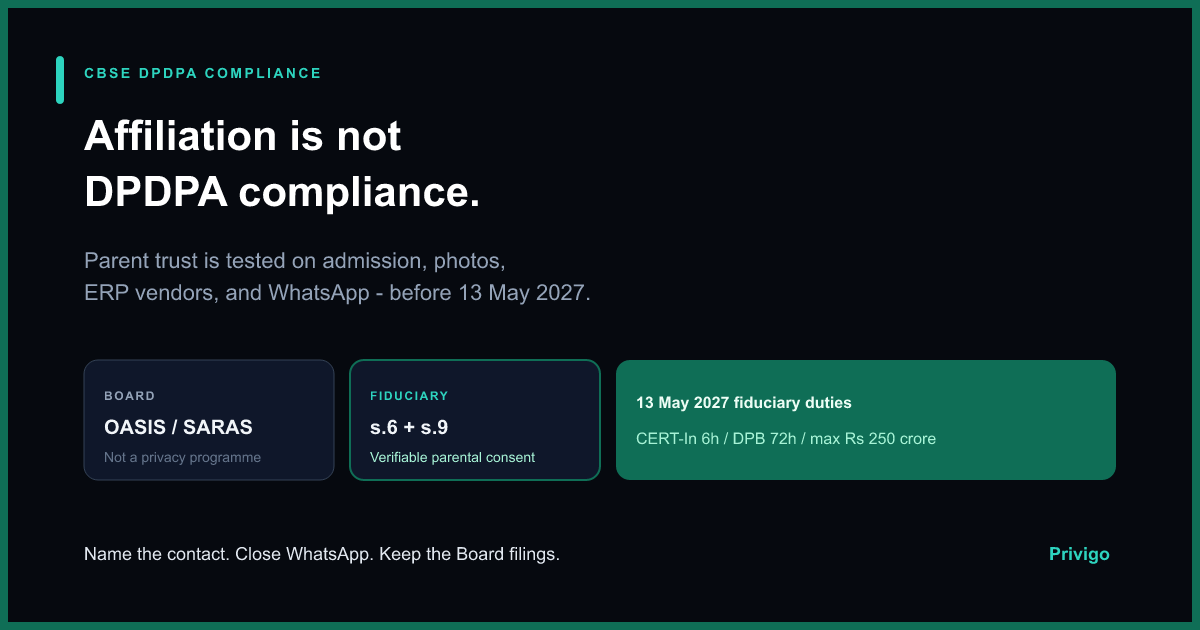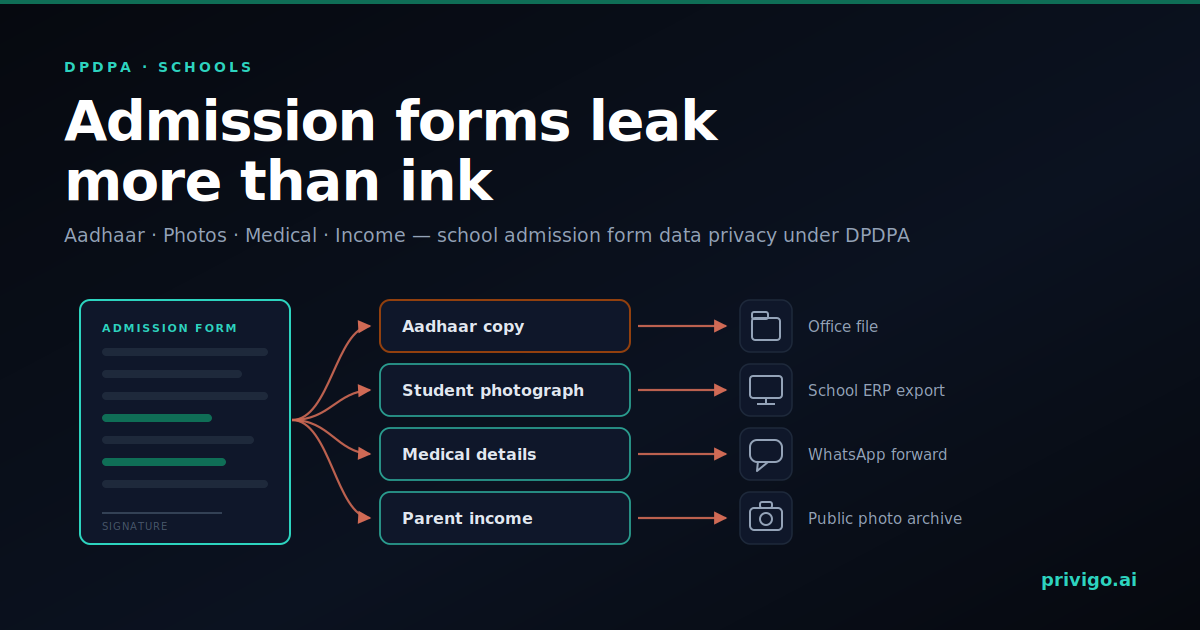
- Premium CBSE / ICSE / IB schools should redesign admission consent architecture before full DPDPA substantive obligations take effect (including phased commencement from 13 May 2027).
- Under Section 6 of the Digital Personal Data Protection Act, 2023 (DPDPA), consent must be free, specific, informed, unconditional, unambiguous, and given through clear affirmative action.
- Income documents, caste/community certificates, medical records, and public photo use each require purpose-specific consent—not one bundled admission declaration.
- Schools act as Data Fiduciaries; ERP/LMS processors and channels like WhatsApp need explicit DPDPA-aligned contractual and operational controls.
- A single omnibus signature on the admission form is generally not enough for purpose-level compliance defensibility.
What Does DPDPA Require for Parental Consent in School Admissions?
The Digital Personal Data Protection Act, 2023 (DPDPA) is India’s central law governing digital personal data. It is enforced by the Data Protection Board of India (DPBI). Private schools that collect and process admission-related personal data of Indian residents act as Data Fiduciaries under the Act. For admission workflows, Section 6 requires consent that is free, specific, informed, unconditional, unambiguous, and given through clear affirmative action—not a single catch-all declaration.
For most CBSE, ICSE, and IB schools, admission forms have evolved for operational convenience, not purpose-based data governance. One signature often tries to cover fee assessment, health records, photos, communication channels, and third-party processing in one shot. That is exactly where avoidable DPDPA risk starts.
Parental consent for school admissions is no longer a paperwork ritual. It is an operational control. If schools want defensible compliance, they need to prove three things: what they collect, why they collect it, and how each purpose is governed across internal teams and vendors.
This guide is written for principals, admission heads, and compliance owners preparing for upcoming cycles.
Why Your Current Admission Form Likely Fails the DPDPA Consent Test
Most legacy forms use broad statements such as: “I authorize the school to use this information as required.”
That is difficult to defend if a parent asks for purpose-level accountability.
Under Section 6 of the DPDP Act 2023, consent must be free, specific, informed, unconditional, unambiguous, and given through clear affirmative action. In practical terms:
- parents should know exactly what data is collected,
- each data category should map to a clearly stated purpose,
- recipients (including vendors) should be disclosed,
- retention logic should be visible,
- withdrawal should be operationally possible.
For a cohort-wide baseline before you redesign forms, see our DPDP compliance guide for Indian schools.
A single omnibus declaration makes all of this hard to prove.
There is another common mistake: schools treat all fields as one legal bucket. They are not. Admission administration, public photo publishing, medical handling, and scholarship/fee document processing are different operational purposes and should be governed accordingly.
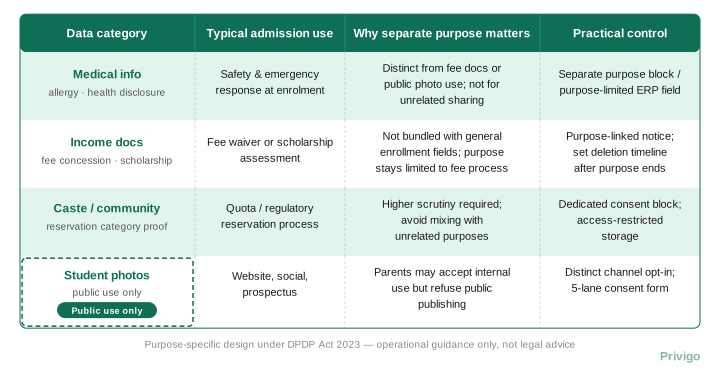
Which Admission Data Categories Need Separate Consent Handling
The Act does not create the old “sensitive personal data” category used in earlier Indian frameworks. But some categories are clearly higher risk in school operations and should be handled with stricter purpose-level controls. ICSE-led schools can cross-check flows against our DPDPA for ICSE schools programmatic guide.
Practical classification for admission workflows
| Data category | Typical use | Practical handling |
|---|---|---|
| Parent/guardian contact details | Admission communication | Clear purpose notice |
| Student profile data | Enrollment administration | Purpose-linked notice |
| Medical information | Safety / emergency response | Separate purpose block recommended |
| Income documents | Fee concession / scholarship | Separate purpose block recommended |
| Caste/community documents | Reservation/regulatory process | Separate purpose block recommended |
| Student photos (internal) | ERP profile / ID card | Separate purpose block |
| Student photos (public) | Website/social/prospectus | Distinct purpose-wise opt-in |
| Biometrics (if used) | Attendance/access | Separate high-governance flow |
What schools should stop collecting by habit
A useful internal test: can the admin team explain each field in one sentence:
- Why this data is needed
- Who uses it
- How long it is retained
- What happens if consent is withdrawn
If that answer is unclear, the field is likely legacy clutter and should be removed or narrowed.
Student Photos Under DPDPA: One Image, Multiple Purposes
Many schools assume one admission-time photo consent covers all downstream use. It does not, unless each downstream purpose was clearly disclosed and accepted.
Five common photo uses schools should separate
- ERP/internal profile identification
- ID card and campus operations
- Yearbook/print publication
- Website/blog publication
- Social media/promotional campaigns
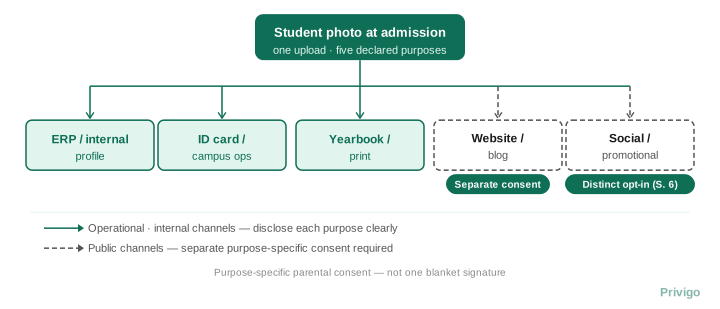
Parents may accept internal use and refuse public publishing. Your workflow should support that distinction without creating admission friction.
Legacy photo archives
Where historical photos were collected under vague language, schools should run a remediation plan:
- inventory existing photo locations (ERP, drives, social handles, archives),
- tag each use by purpose,
- refresh consent where needed for ongoing public-facing use,
- suspend non-essential public use where consent trail is weak.
Building a Compliant Parent Consent Letter for School Admissions
A compliant consent notice is not necessarily longer. It is clearer and purpose-mapped.
Under Section 5 (notice) and Section 6 (consent), schools should ensure admission notices include:
- Data Fiduciary identity (school legal name + grievance channel)
- Exact data fields (not vague labels)
- Purpose per category in plain language
- Third-party recipients (ERP/LMS/transport/etc.) where relevant
- Retention period or retention criteria
- Withdrawal mechanism and operational impact
Digital vs paper consent
Both media can be used. The stronger differentiator is auditability:
- what version of notice was shown,
- when consent was captured,
- which purposes were accepted/rejected,
- whether withdrawal was logged and actioned.
For most schools, digital admission systems make this evidence easier to maintain than paper-only workflows.
Do Schools Need DPDPA Clauses in ERP, LMS, and WhatsApp Vendor Agreements?
Form-level compliance is only the front end. Major exposure usually appears after data moves to tools.
ERP/LMS contracts: subscription terms are not enough
Section 8 keeps responsibility on the Data Fiduciary even when processing is done via a Data Processor. So schools should verify processor-grade clauses in vendor contracts:
- purpose limitation,
- security safeguards,
- breach escalation obligations,
- sub-processor controls,
- retention/deletion at termination,
- audit/assurance rights.
If your team needs implementation detail, map contract reviews to our DPDPA vendor DPA clause library for schools (ERP, LMS, and edtech processors).
WhatsApp admission workflows
Schools often use WhatsApp for shortlist updates, interviews, and onboarding messages. This creates practical governance risks:
- broad participant visibility of phone numbers and names,
- limited institutional control over downstream use,
- difficult deletion assurance across distributed chat contexts.
Schools should treat this as a communication governance decision, not an ad hoc convenience decision. At minimum, document what data is allowed on messaging channels and route sensitive admission payloads through controlled systems.
What Happens to Admission Data When a Parent Withdraws Consent or a Student Does Not Enroll?
Most schools focus on collecting consent, not closing the lifecycle.
The Act generally requires erasure when consent is withdrawn and the specified purpose is no longer served, unless retention is required by law. Operationally, this means schools need a written retention/deletion SOP rather than case-by-case handling.
Rejected or waitlisted applicants
For applicants who never enroll, schools should define:
- post-cycle retention window,
- lawful retention exceptions (if any),
- deletion trigger and responsibility owner,
- evidence trail of completion.
Without that, old applicant data becomes unmanaged liability.
Pre-Admission DPDPA Readiness Checklist (School Operations)
A) Form and consent architecture
- Separate purpose blocks for higher-risk categories
- Photo consent split by use channel
- School identified as Data Fiduciary with grievance path
- Third-party recipients disclosed where applicable
- Retention criteria documented
- Withdrawal method clearly stated
- Consent language plain and parent-readable
- Notice accessibility plan (including language support where needed)
- Consent event logging enabled (timestamp/version)
- Legacy fields removed or purpose-justified
B) Vendor and platform controls
- ERP processor obligations documented
- LMS obligations aligned similarly
- Admission messaging policy approved
- Vendor breach-response alignment checked
- Deletion-at-termination obligations present
C) Governance ownership table
| Area | Owner | Status |
|---|---|---|
| Admission form redesign | Admin Head | ☐ |
| Consent notice review | Compliance owner | ☐ |
| ERP/LMS contract review | IT + Legal | ☐ |
| Photo-use remediation | Admissions + Comms | ☐ |
| Retention/deletion SOP | Principal + Compliance | ☐ |
FAQs
Do schools need separate consent for income, caste, and medical fields on one admission form?
Yes. Schools should use separate, purpose-specific consent blocks for income documents, caste or community certificates, and medical information when each serves a distinct admission function. Under Section 6 of the Digital Personal Data Protection Act, 2023 (DPDPA), consent must be specific and informed—a single bundled declaration on one admission form is weak evidence that parents agreed to each distinct use.
Can we post student photos on Instagram/website if parents signed a general admission form?
No, not on the basis of a general admission form alone. Posting student photos on Instagram, the school website, or similar public channels is a separate purpose from internal admission administration and requires its own clear, purpose-specific opt-in under DPDPA Section 6 unless that public use was explicitly disclosed and accepted at collection.
How quickly should a school delete data after a parent withdraws and the student does not enroll?
Best practice is deletion within 90 days of admission cycle closure when the student does not enroll and no lawful retention exception applies. Retention may be longer where required by law or documented regulatory needs (for example, certain RTE or record-keeping obligations). The DPDPA does not prescribe one universal number; erasure is generally required when consent is withdrawn and the stated purpose is no longer served.
Does our ERP vendor need processor-style clauses before admission data upload?
Yes. Under Section 8 of the DPDPA, the school remains accountable as Data Fiduciary even when an ERP processes admission data on its behalf, so processor-style contractual obligations—purpose limitation, security safeguards, breach escalation, and deletion at termination—should be documented before upload.
Is WhatsApp for admission communication a DPDPA risk?
Yes, WhatsApp admission workflows carry meaningful DPDPA risk. Group chats expose applicant phone numbers and personal details to broad participant visibility, offer limited institutional control over downstream use, and provide no reliable deletion assurance or audit trail compared with governed admission systems.
Closing
Admission forms are released months before classes start, but consent architecture should be fixed well before the cycle opens. For premium private schools (CBSE / ICSE / IB), this is the right window to move from legacy declarations to auditable, purpose-based compliance workflows.
If your team is reviewing admissions readiness this quarter, start with three changes:
- purpose-specific consent redesign,
- ERP/LMS contract hardening,
- retention/deletion SOP for non-enrolled applicants.
That closes a large part of practical exposure before the next cycle.
Book a Privigo demo — map admission consent to live workflows
Sources
-
Digital Personal Data Protection Act, 2023 (official text)
https://www.meity.gov.in/static/uploads/2024/06/2bf1f0e9f04e6fb4f8fef35e82c42aa5.pdf -
Digital Personal Data Protection Rules, 2025 commencement notification (G.S.R. 843(E))
https://www.meity.gov.in/static/uploads/2025/11/c56ceae6c383460ca69577428d36828b.pdf -
PIB reference note on DPDP Rules notification
https://www.pib.gov.in/PressReleasePage.aspx?PRID=2190014 -
DP Board operationalisation media report (for context only; verify against primary release before publication)
https://www.adgully.com/post/15479/meity-moves-to-operationalise-data-protection-board-under-dpdp-act-with-new-appointments
This article provides operational compliance guidance and does not constitute legal advice. Schools should obtain institution-specific legal counsel where required.